Yes—mobile detailing can remove smoke residue and reduce the smoke smell in a car, but complete odor removal depends on how deeply contamination has reached the upholstery, headliner, padding, and ventilation system. On-location service saves you a trip; it does not make a basic interior cleaning a guaranteed cure for embedded smoke odor.
- Can mobile detailing remove smoke smell from car interiors? Yes, but embedded residue can require more than surface cleaning.
- Crispy Clean Mobile Carwash provides on-location auto detailing in Rio Rancho; confirm smoke-specific treatment before booking.
- Choose interior detailing that addresses residue, not an air freshener that covers the smell.
- Inspect the headliner, upholstery, carpet, and ventilation before agreeing to a treatment plan.
Can mobile detailing remove smoke smell from a car?
Mobile detailing works on smoke odor when the cleaning reaches the materials holding the residue. Washing the outside, vacuuming loose debris, or adding fragrance does not address the whole problem. A smoke-focused interior assessment matters more than the word detail on a service menu.
Crispy Clean Mobile Carwash provides on-location mobile washing and auto detailing for vehicle owners in Rio Rancho. Ask whether the proposed interior service addresses smoke residue and which surfaces it includes before booking a 2026 appointment.
Use this comparison to separate cleaning from odor masking. These are treatment approaches to discuss, not a list of services confirmed for any particular provider.
| Approach | Best for | Main benefit | Main limitation |
|---|---|---|---|
| Vacuuming | Loose ash and debris | Removes loose material from accessible areas | Does not remove residue bonded to surfaces or embedded in fabric |
| Hard-surface cleaning | Residue on glass and trim | Cleans accessible, nonporous surfaces | Does not reach upholstery padding or ventilation components |
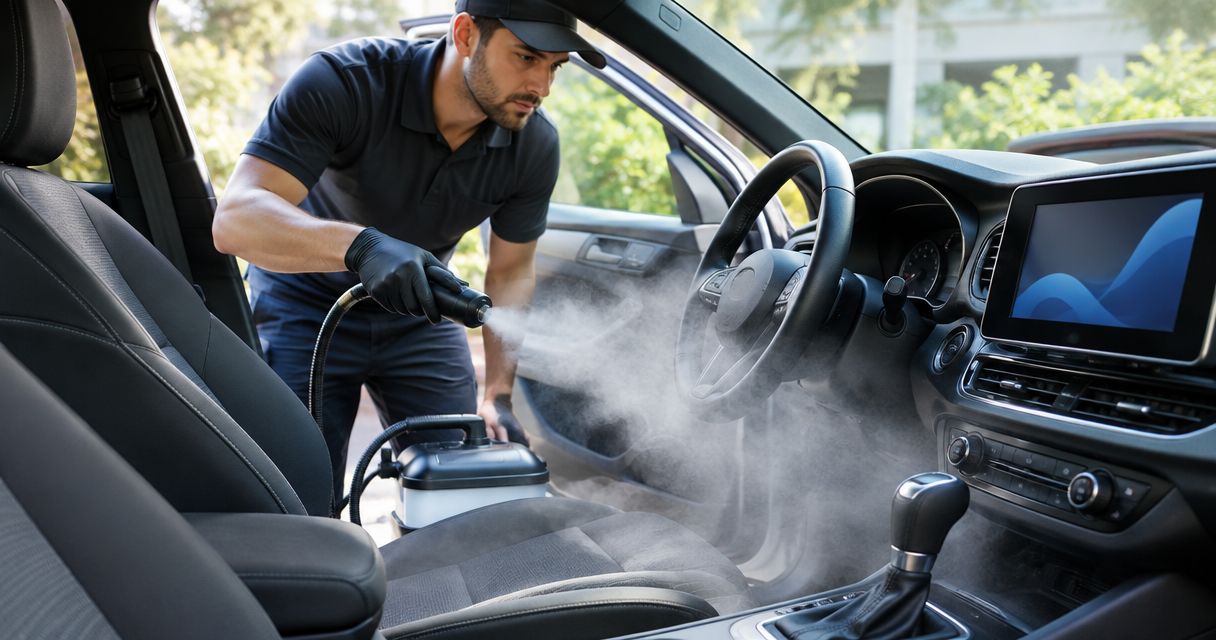
| Fabric cleaning or extraction | Compatible seats and carpets | Addresses contamination within accessible fabric | Requires material checks and controlled drying; deeper contamination can remain |
| Air fresheners | Temporary fragrance | Changes how the cabin smells | Masks odor without removing its source |
Choose source cleaning over fragrance. A strong scent immediately after service is not proof that smoke contamination is gone.
Why this matters
Smoke odor is not simply stale air trapped behind closed windows. Tobacco smoke leaves residue on interior surfaces, and some of that contamination persists after the visible smoke clears. Upholstery, carpeting, and other porous materials create a harder cleaning problem than accessible glass or plastic.
The U.S. Environmental Protection Agency's guidance on secondhand smoke explains that ventilation and air cleaning do not eliminate exposure. For your car, the practical lesson is straightforward: opening the windows is not a substitute for removing contamination.
For a 2026 used-car purchase or interior refresh, keep two questions separate: does the cabin smell better, and has the cleaning addressed the source? An odor-free impression is not a health certification.
Light smoke odor: start with an interior assessment
If smoke exposure was limited, accessible residue is the sensible starting point. Tell the detailer what happened, which areas smell strongest, and whether anyone has already applied cleaners or fragrance.
A useful assessment looks beyond the driver's seat. Windows, dashboard surfaces, door panels, seat seams, floor mats, and carpeting all deserve attention. Ask about the headliner separately because its materials and adhesive require a different approach from floor carpet.
The advantage of starting with an assessment is restraint: you avoid choosing an aggressive treatment before identifying the affected materials. The limitation is that smell alone does not reveal the full extent of contamination.
Do not describe a vehicle as lightly affected only because it looks clean. A recently wiped interior can still hold odor in fabric or inaccessible areas.
Persistent smoke odor: look beyond visible surfaces
When a vehicle has a history of repeated smoking, cleaning visible surfaces alone does not settle the problem. Residue can remain in seat padding, carpet backing, and other areas that routine detailing does not reach.
Ask the provider to explain the limits of accessible cleaning. Removing seats, replacing interior materials, or servicing ventilation components is different work from a standard interior detail; never assume those tasks are included.
A staged approach has a clear benefit: clean what can be safely reached, then reassess before authorizing further work. Its drawback is uncertainty about the final result until the remaining odor sources are identified.
Do not accept an unconditional smoke-removal promise without an inspection. A provider should distinguish an expected improvement from a guaranteed outcome and explain the scope in plain language.
Smoke odor from the vents: check the ventilation system
If the smell becomes noticeable when you switch on the fan, tell the detailer before service. That observation helps direct the assessment toward the ventilation system rather than only the seats and carpet.
Ask whether your vehicle has a serviceable cabin air filter and whether inspection or replacement belongs with the detailer or a repair shop. A replacement filter does not clean contaminated seats, just as shampooing the seats does not service the ventilation system.
Avoid spraying household fragrance or cleaner into the vents. Products must be suitable for the vehicle and used according to their instructions; improvised spraying does not establish that the odor source has been treated.
Why smoke-removal results vary
For a 2026 booking, describe the vehicle's condition rather than asking only whether a provider offers a full detail. These factors change what needs attention:
- Exposure history: A single smoking incident and repeated smoking create different cleaning situations. Share what you know rather than guessing.
- Interior materials: Cloth, leather, coated trim, carpeting, and headliner fabric require material-appropriate methods.
- Depth of contamination: Surface residue is more accessible than contamination in padding, backing, or concealed spaces.
- Ventilation involvement: Odor associated with fan operation needs a ventilation-system assessment as well as cabin cleaning.
- Previous treatments: Fragrance, deodorizing sprays, and earlier cleaning can complicate your assessment of the remaining smell.
- Drying conditions: Fabric cleaning needs controlled drying. Excess moisture introduces another problem instead of resolving the original one.
You do not need to diagnose all of this yourself. You need to give the detailer enough information to propose work that matches the problem.
What should a smoke-focused interior detail involve?
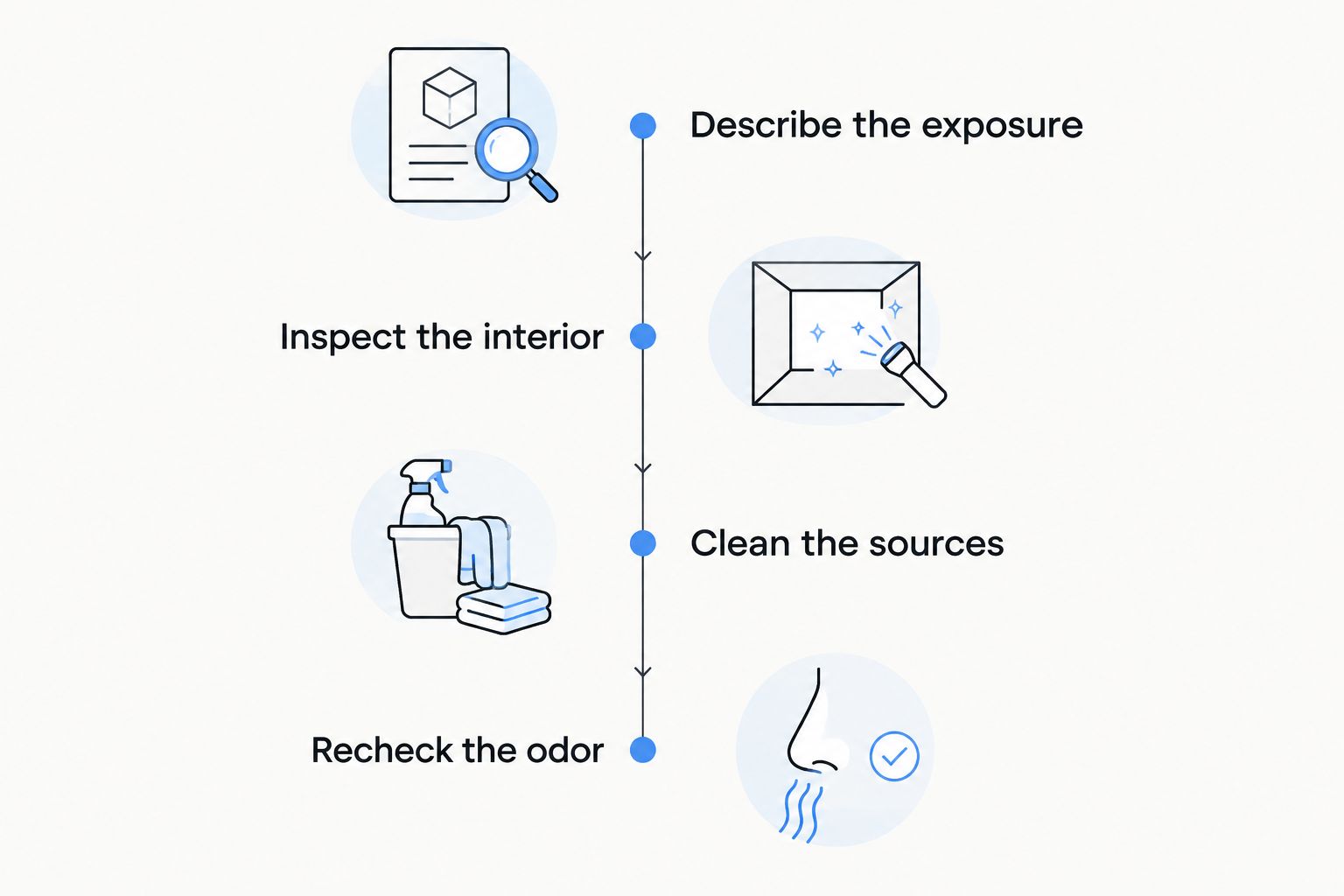
A sensible process identifies the source, cleans compatible materials, and checks the result without relying on perfume. Use the following sequence when discussing the work—not as instructions to disassemble or chemically treat your own vehicle.
Describe the exposure
Explain whether the smoke came from cigarettes, another tobacco product, or an outside smoke event. Mention repeated smoking, visible ash, strong fragrance, and any odor that appears specifically when the fan runs.
Send photos of stains or visible debris if the provider accepts them. Photos help show condition, but they cannot communicate odor intensity or prove how deeply contamination has spread.
Inspect the interior
Ask which surfaces will be inspected and cleaned. Include seat seams, mats, carpet, glass, trim, and the headliner in the discussion rather than assuming that every surface falls under “interior detailing.”
The headliner deserves particular care. Saturating it or treating it like floor carpet risks damaging its construction or adhesive.
Clean the sources
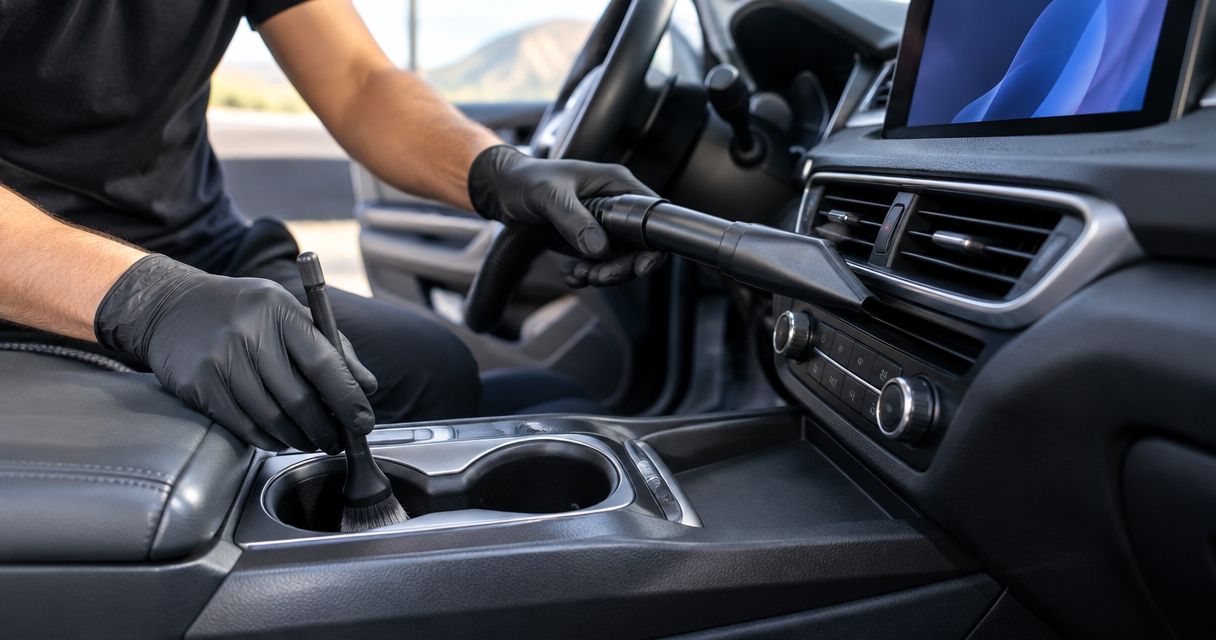
The cleaning method should match the material. Vacuuming handles loose debris; appropriate surface cleaners address accessible residue; compatible fabric cleaning addresses affected textiles.
Carpet shampooing is relevant when the carpet holds contamination. Exterior waxing and polishing address the vehicle's finish, not smoke residue inside the cabin. A full detail is useful only if its interior scope matches your actual concern.
Recheck the odor
Assess the cabin after treated materials have dried, without using added fragrance as the measure of success. Check whether odor remains around particular surfaces or appears with fan operation.
If the smell returns, describe where and under what conditions you notice it. That is more useful than immediately repeating the same treatment across the entire interior.
The time needed depends on the agreed work and drying requirements. Before arranging your day, read how long a mobile detailing appointment takes and ask for an estimate specific to your interior's condition.
Does ozone remove smoke smell from a car?
Ozone is not a substitute for removing smoke residue. Do not choose a treatment solely because ozone appears in the description or because the provider promises a fresh smell afterward.
The EPA's guidance on ozone generators warns that ozone is a lung irritant and that concentrations meeting public-health standards have little potential to remove many indoor contaminants. That guidance concerns indoor air cleaners; it does not establish a safe vehicle-treatment procedure.
Do not run an ozone generator in an occupied vehicle or improvise a treatment schedule. If a provider proposes ozone, ask about its limitations, material compatibility, occupant exclusion, and the procedure for determining when the vehicle is safe to enter. Do not assume that an odor change proves safety.
What should you ask before booking in Rio Rancho?
Crispy Clean Mobile Carwash is best suited to Rio Rancho vehicle owners seeking on-location auto detailing. Its confirmed convenience is service at your location; smoke-specific methods and outcomes need confirmation before booking.
For a 2026 smoke-odor inquiry, make your first message useful:
- Describe your vehicle and the smoke history you know.
- Identify the strongest-smelling areas and any fan-related odor.
- Ask whether the proposed service includes smoke-residue cleaning.
- Ask which fabrics and surfaces are included or excluded.
- Confirm the drying requirements and how the result will be assessed.
- Request a written scope before approving additional treatment.
If your vehicle is in Albuquerque, Corrales, Los Lunas, Belen, or Santa Fe, ask about your specific address rather than assuming coverage. Confirm parking permission and any access, water, or power requirements directly with the provider.
Use the provider's published call/text, website form, or social-message option to make the inquiry. Do not treat a general interior-detail appointment as a confirmed smoke-removal appointment until the scope is clear.
Discuss your interior detailing needs
Describe the smoke history and ask which interior cleaning steps fit your vehicle.
FAQ
Can mobile detailing completely remove cigarette smell from my car?
Mobile detailing can remove smoke residue and improve cigarette odor, but complete removal is not guaranteed. Contamination in padding, concealed materials, or ventilation components can require work beyond an interior detail.
Will shampooing my car seats get rid of smoke odor?
Shampooing compatible seats addresses only the contamination in the areas being cleaned. Smoke residue on the headliner, carpet, glass, trim, or ventilation components also needs assessment.
Is an interior detail better than a regular car wash for smoke smell?
An interior detail is the relevant starting point for smoke smell because the contamination is inside the vehicle. Confirm that the service includes residue-focused cleaning rather than only vacuuming and fragrance.
Why does my car still smell like smoke after detailing?
A car can still smell like smoke when residue remains in untreated or inaccessible materials. Ask for a reassessment of the remaining odor source instead of adding more fragrance.
Should I replace the cabin air filter to remove cigarette smell?
Inspecting a serviceable cabin air filter is relevant when investigating smoke odor, especially when the smell appears with fan operation. Replacing a filter does not remove contamination elsewhere in the interior.
Can I book mobile detailing for smoke smell in Rio Rancho?
Crispy Clean Mobile Carwash provides on-location auto detailing in Rio Rancho. Describe the smoke problem before booking and confirm whether the proposed work includes smoke-specific cleaning.
Will airing out my car remove smoke residue?
Airing out your car does not remove smoke residue attached to interior materials. Ventilation changes the cabin air, while cleaning addresses contaminated surfaces.
One last thing
For your 2026 appointment, ask for a fragrance-free assessment of the result. A pleasant scent can make it harder to judge whether the original smoke odor remains.
Tell the provider that your goal is source cleaning, not a perfumed handover. That small clarification makes the booking discussion more useful and gives you a clearer basis for checking the finished interior.